

Hip Conditions
Dr. Boyle treats the following hip conditions:
Hip Dysplasia
Hip dysplasia is a condition in which the hip socket (acetabulum) is too shallow to fully cover the ball of the hip joint (femoral head), resulting in abnormal load distribution across the joint. Over time, this leads to damage of the hip labrum and articular cartilage, and - if left untreated - progressive hip arthritis. Hip dysplasia is more common in women and may present in adolescence or early adulthood with groin pain, labral tears, and reduced hip function.
Dr. Boyle specialises in the surgical treatment of hip dysplasia, including periacetabular osteotomy (PAO) - the gold standard hip preservation procedure for this condition. For detailed information about hip dysplasia and its treatment, visit the dedicated Hip Dysplasia page.
Femoroacetabular Impingement (FAI)
Femoroacetabular impingement (FAI) occurs when abnormal contact between the ball and socket of the hip joint causes pain, cartilage damage, and labral tears. It is one of the most common causes of hip and groin pain in active adults and young sportspeople, and is frequently seen in footballers, hockey players, cyclists, rowers, and martial artists. FAI may be caused by extra bone on the ball of the hip (cam impingement), the rim of the socket (pincer impingement), or a combination of both. Left untreated, FAI can cause progressive joint damage and early hip arthritis.
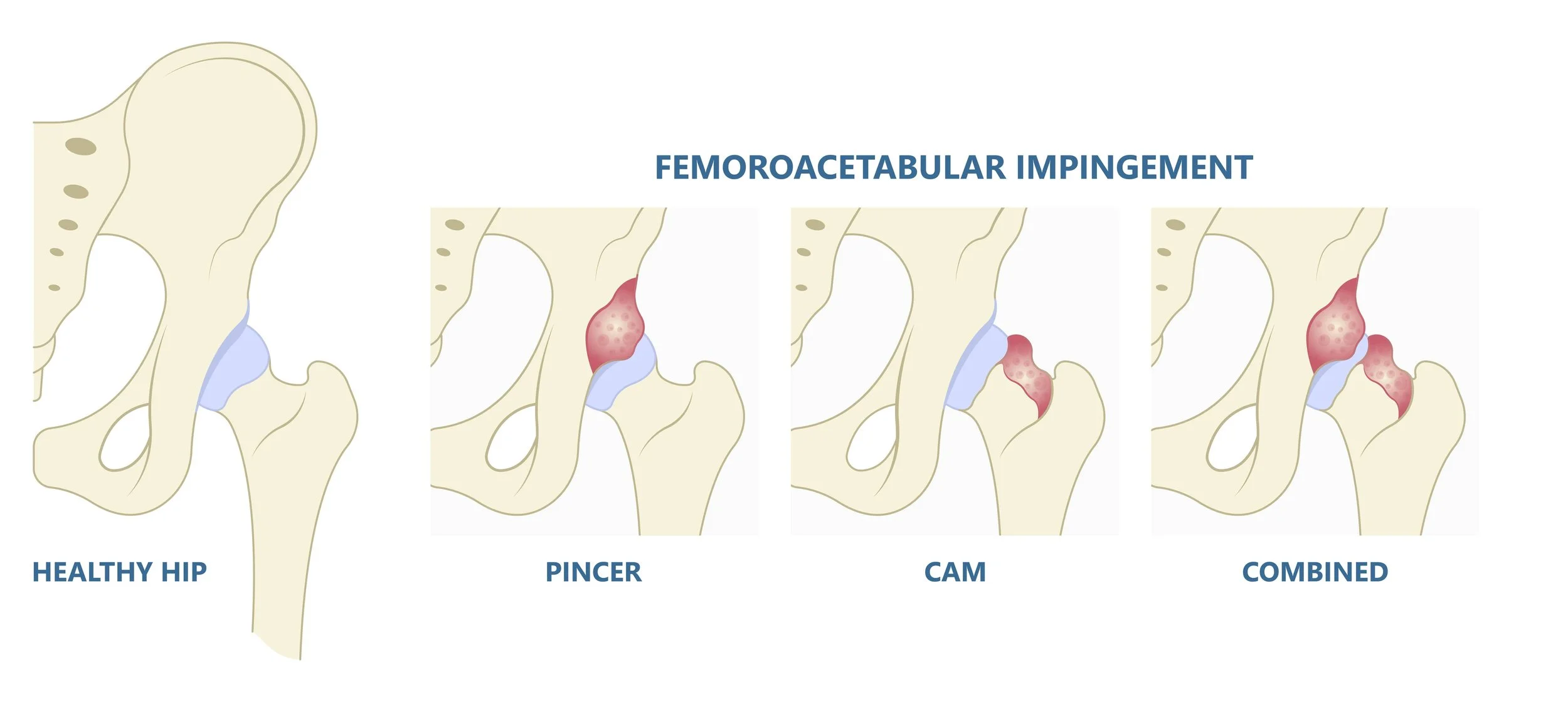
CAM-type FAI
CAM impingement is caused by a bony prominence on the femoral head (ball) or femoral neck that is not perfectly round. As the hip moves - particularly into flexion and internal rotation - this non-spherical shape jams against the rim of the socket, shearing the labrum and damaging the adjacent cartilage. CAM deformities are more common in males and in those who participated in high-volume sport during adolescence, when the growth plate of the femoral head was still developing. Arthroscopic reshaping of the femoral head (femoroplasty) relieves the impingement and allows labral repair.
Pincer-type FAI
Pincer impingement is caused by over-coverage of the femoral head by the acetabular rim - either globally (a deep socket, or coxa profunda) or locally (a rim that projects too far forward). As the hip flexes, the femoral neck contacts the rim of the socket, crushing the labrum between them. Pincer FAI is more common in females and in those with certain pelvic anatomy. Arthroscopic trimming of the acetabular rim (acetabuloplasty) reduces the over-coverage and allows the underlying labrum to be repaired.
Osteonecrosis of the Hip (Avascular Necrosis)
Osteonecrosis - also known as avascular necrosis (AVN) - occurs when the blood supply to the femoral head is disrupted, causing the bone to die and eventually collapse. It can result from a hip fracture or dislocation (ACC-eligible), prolonged corticosteroid use, excessive alcohol consumption, certain medical conditions, or may occur without an identifiable cause. Osteonecrosis progresses through stages: in early stages, before collapse has occurred, hip preservation procedures can be considered to restore blood flow and prevent further deterioration. Once the femoral head has collapsed, hip replacement is typically required. Early diagnosis - through MRI - is critical to maximising treatment options.
Osteochondral Injury of the Hip
An osteochondral injury of the hip involves damage to both the articular cartilage and the underlying bone of the hip joint, typically occurring as a result of acute trauma, FAI, or hip dislocation. Osteochondral defects can cause localised pain, clicking, and progressive joint damage if left untreated. Treatment depends on the size and location of the defect and the integrity of the overlying cartilage - options range from arthroscopic debridement and marrow stimulation to osteochondral fixation or cartilage restoration procedures. ACC cover may apply when the injury resulted from an acute accident.
Legg-Calvé-Perthes Disease (Perthes Disease)
Perthes disease is a childhood condition in which the blood supply to the femoral head is temporarily disrupted, causing the bone to soften, deform, and then re-grow over a period of years. It most commonly affects children aged 4-10 and is more common in boys. The deformity that results during the healing phase can alter the shape of the femoral head and socket, leading to impingement, labral tears, and early arthritis in adulthood. Management during childhood aims to maintain the femoral head within the socket during the healing process. Adults with residual deformity from childhood Perthes disease may require hip preservation surgery or hip replacement depending on the degree of joint damage.
Slipped Upper Femoral Epiphysis (SUFE)
Slipped upper femoral epiphysis (SUFE) is a condition affecting adolescents in which the growth plate at the top of the femur becomes unstable, allowing the femoral head to slip backwards and downwards relative to the femoral neck. It is more common in overweight adolescent males and requires prompt surgical treatment - typically fixation with a screw - to prevent further slippage and reduce the risk of osteonecrosis. Significant slips that are not treated early can result in a permanent deformity of the femoral head and neck, causing impingement, labral damage, and early hip arthritis in adulthood. In selected patients with residual deformity, surgical correction of the hip geometry may be appropriate.
Gluteal Tendon Tears
The gluteal tendons attach the gluteal muscles (gluteus medius and minimus) to the greater trochanter - the bony prominence on the outer side of the hip. Gluteal tendon tears and tendinopathy are a common cause of lateral hip pain, particularly in middle-aged and older women. Symptoms include pain over the outer hip and thigh, tenderness directly over the greater trochanter, and pain when lying on the affected side or crossing the legs. Most cases respond to a structured physiotherapy programme and load management. Significant tears causing persistent pain and weakness may benefit from surgical repair, combined with lengthening of the iliotibial band, which can be performed arthroscopically or through a small open incision.
Hip Bursitis (Greater Trochanteric Bursitis)
Hip bursitis refers to inflammation of the bursa - a fluid-filled sac - overlying the greater trochanter on the outer side of the hip. It is one of the most common causes of lateral hip pain and frequently coexists with gluteal tendon pathology. Symptoms include aching pain over the outer hip that is aggravated by walking, climbing stairs, and lying on the affected side. The condition is more common in women and in those with altered lower limb biomechanics. Treatment is predominantly non-operative, including physiotherapy, activity modification, and corticosteroid injection. Persistent cases may benefit from bursectomy and iliotibial band lengthening.
Psoas Tendonitis
The iliopsoas (psoas) tendon runs from the lower back and pelvis, across the front of the hip joint, to attach to the inner femur. Psoas tendonitis refers to inflammation of this tendon and its surrounding sheath, causing deep groin or anterior hip pain that is typically aggravated by hip flexion activities - such as climbing stairs, getting in and out of a car, and sitting upright. It is commonly seen in dancers, runners, and those who perform repetitive hip flexion. Most cases respond well to physiotherapy targeting the hip flexors and core. Persistent cases may benefit from ultrasound-guided injection or, in refractory situations, arthroscopic psoas tendon release.
Psoas Impingement after Hip Replacement
Psoas impingement is a recognised complication following total hip replacement in which the iliopsoas tendon becomes irritated by contact with the acetabular component of the implant. It presents as anterior (groin) hip pain after otherwise successful hip replacement surgery, often reproduced by resisted hip flexion. Diagnosis requires clinical assessment and imaging to exclude other causes of pain. Treatment typically begins with physiotherapy and corticosteroid injection. When conservative measures fail, surgical options include arthroscopic psoas tendon lengthening or revision of the acetabular component if it is significantly overhanging.
Piriformis Syndrome
The piriformis is a small muscle deep in the buttock that rotates the hip outward. Piriformis syndrome occurs when this muscle irritates or compresses the sciatic nerve as it passes nearby, causing buttock pain and sciatica-like symptoms radiating down the leg. It is a diagnosis of exclusion - other causes of sciatic nerve irritation, including lumbar disc pathology, must be ruled out first. Most cases respond to physiotherapy targeting the piriformis and surrounding hip rotators, along with activity modification. In refractory cases, ultrasound-guided injection into the piriformis muscle or surgical release of the muscle and sciatic nerve may be considered.
Snapping Hip (Coxa Saltans)
Snapping hip describes an audible or palpable snapping sensation around the hip joint with movement. It has two common causes: external snapping, in which the iliotibial band (IT band) or gluteus maximus tendon flicks over the greater trochanter; and internal snapping, in which the iliopsoas tendon snaps over a bony prominence at the front of the hip. In most cases, snapping hip is painless and requires no treatment beyond reassurance and physiotherapy. When the snapping is painful and does not respond to conservative management, arthroscopic release of the responsible structure is an effective option.
To arrange a specialist assessment for any of the above conditions, ask your GP or physiotherapist to refer you to Dr. Matthew Boyle at Auckland Bone and Joint Surgery. Referrals can be sent via HealthLink EDI: drmboyle, or by calling 09 281 6733. Dr. Boyle consults at AUT Millennium, 17 Antares Place, Rosedale, North Shore Auckland.
Frequently Asked Questions
-
The most common causes of hip pain in young and active adults are femoroacetabular impingement (FAI), hip labral tears, and hip dysplasia. These conditions cause deep groin pain, a clicking or catching sensation, and pain with sitting, pivoting, or sport. Unlike hip osteoarthritis - which is more common in older patients - these conditions are structural and are best identified and treated early, before progressive cartilage damage occurs. An MRI is the most useful investigation for diagnosing labral and cartilage pathology in the hip.
-
FAI occurs when extra bone on the femoral head, the acetabulum, or both causes abnormal contact and friction within the hip joint during movement, damaging the labrum and cartilage over time. This is essentially the opposite structural problem to hip dysplasia, where the socket is too shallow rather than causing excess contact. Both can cause similar symptoms - groin pain, clicking, and pain with pivoting - but the underlying bony abnormality and the specific surgical approach differ, which is why accurate imaging and diagnosis matter.
-
Yes. Hip preservation surgery aims to treat the underlying cause of hip pain in young patients while retaining the native hip joint, avoiding or delaying the need for hip replacement. Procedures such as arthroscopic hip surgery for FAI and labral tears, and periacetabular osteotomy (PAO) for hip dysplasia, are highly effective in appropriately selected patients. The best outcomes are achieved when treatment is undertaken before significant cartilage damage has occurred, which is why early assessment is important.
-
Acetabular retroversion is a structural variation in which the hip socket faces slightly backward rather than in its usual orientation, which can cause a specific type of impingement between the femur and the front rim of the socket. It's a less common but important cause of hip pain in young adults that requires specific recognition on imaging, since the treatment approach differs from typical FAI or dysplasia.
-
Perthes disease is a childhood condition in which the blood supply to the growing femoral head is temporarily disrupted, causing the bone to soften and become at risk of deformity as it heals. It typically affects children between four and ten years of age and can lead to hip problems later in life, including impingement or early arthritis, if the femoral head heals in an irregular shape.
-
Most hip conditions are assessed initially with a clinical examination and imaging - typically X-rays and an MRI. Surgery is considered when a structural abnormality is identified that is causing symptoms and is unlikely to resolve with physiotherapy alone. Many patients with FAI and labral tears benefit from a trial of physiotherapy first. A specialist consultation will clarify the diagnosis, identify any structural issues, and allow a shared discussion about whether non-operative or surgical treatment is the most appropriate path.