
ACL Reconstruction
The anterior cruciate ligament (ACL) is one of the main stabilising ligaments of the knee, and one of the most commonly injured, particularly in sports involving pivoting, jumping, and sudden changes of direction. Dr. Matthew Boyle is a fellowship-trained knee surgeon with extensive experience in ACL reconstruction, including in adolescent and young athlete populations, an area he has also researched and published on.
What Is the ACL and How Is It Injured?
The ACL runs diagonally through the middle of the knee, connecting the femur (thigh bone) to the tibia (shin bone), and provides rotational stability to the joint. Most ACL injuries occur without any contact from another player - typically during a sudden pivot, landing awkwardly from a jump, or rapidly decelerating and changing direction. A smaller proportion result from direct contact, such as a tackle.
ACL tears are common in sports popular in New Zealand, including netball, rugby, football, and skiing, and are seen across a wide age range, from adolescent athletes through to older recreational players.
Symptoms of an ACL Tear
Most patients recall a specific moment of injury, often describing:
A loud pop or crack at the time of injury
Immediate swelling within hours of the injury
A feeling that the knee has given way or is unstable
Difficulty continuing to play or bear weight immediately afterward
Ongoing instability or the knee giving way during pivoting or twisting movements, once the initial swelling has settled
Some patients with a partial tear or a well-compensated knee may have milder symptoms and continue activity for some time before instability becomes apparent.
Diagnosis
Diagnosis begins with a clinical examination, including specific stability tests that assess the integrity of the ACL and other knee ligaments. MRI is used to confirm the diagnosis, assess the severity of the tear, and identify any associated injuries, which are common with ACL tears - particularly to the meniscus (cartilage cushions) or other ligaments.
X-rays are also often taken to rule out any associated fracture, particularly in adolescent patients where growth plates need to be assessed.
Treatment Options
Non-surgical management may be appropriate for lower-demand patients, those planning to avoid pivoting sports going forward, or as an initial approach while swelling and range of motion are optimised before a final decision is made. This centres on structured physiotherapy (often called "pre-habilitation" when done ahead of planned surgery) to restore strength, control swelling, and regain range of motion.
Surgical reconstruction is generally recommended for:
Patients wishing to return to pivoting or contact sport
Younger, active patients, where ongoing instability significantly raises the risk of further knee damage over time
Patients with associated injuries, such as meniscal tears, that benefit from surgical management alongside ACL reconstruction
ACL reconstruction involves replacing the torn ligament with a graft, using the patient's own tissue (autograft). For skeletally mature patients, Dr. Boyle offers both patellar tendon autograft and hamstring tendon autograft reconstruction, with the choice depending on individual factors including age, activity level, and any associated injuries - this is discussed and decided together with each patient prior to surgery. Occasionally, an additional lateral tenodesis procedure may be used in higher-risk patients. Where a meniscal tear is also present, this is typically repaired at the same time as the ACL reconstruction. For adolescent patients with open growth plates, different graft and technique choices apply - see below.
Recovery After ACL Reconstruction
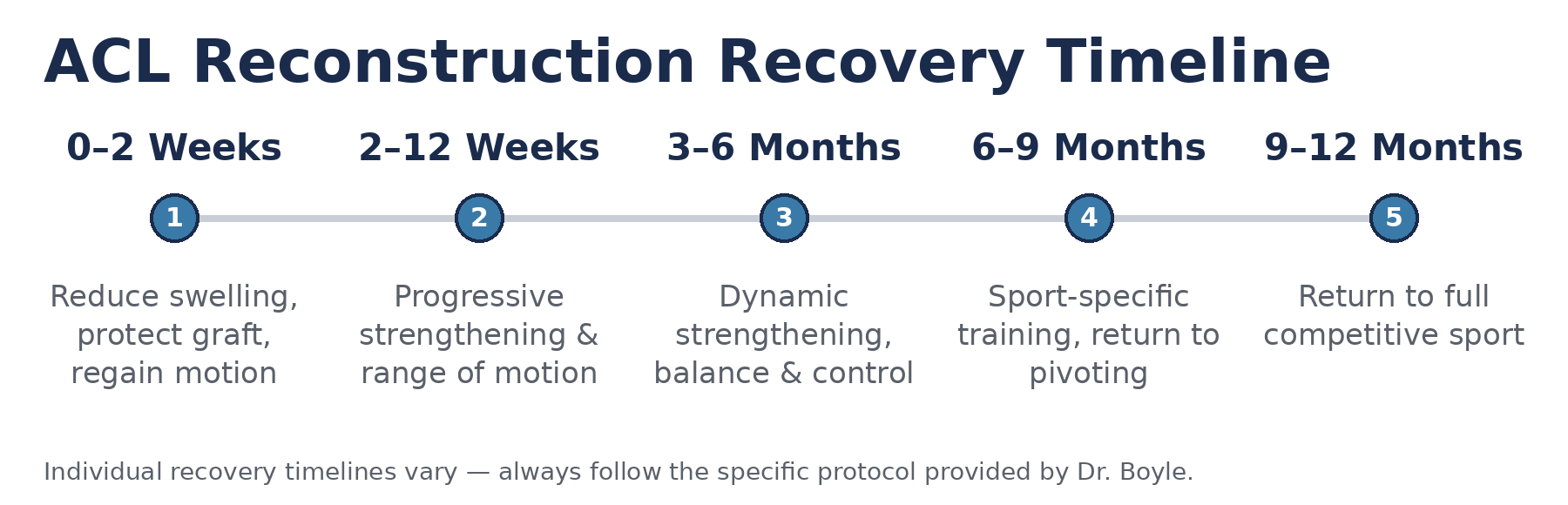
Recovery from ACL reconstruction follows a structured, staged rehabilitation programme:
0-2 weeks: Focus on reducing swelling, protecting the graft, and regaining basic range of motion
2-12 weeks: Progressive strengthening and range of motion work, typically with a physiotherapist
3-6 months: Introduction of more dynamic strengthening, balance, and control exercises
6-9 months: Sport-specific training and gradual return to pivoting activity, guided by strength and functional testing rather than time alone
9-12 months: Return to full competitive sport for most patients, though timelines vary based on graft type, associated injuries, and individual progress
Most patients are able to return to driving within 4 to 6 weeks (less for an automatic car or left-leg surgery) - see our Common Post-Operative Questions page for further post-operative timelines across all procedures.
A note on adolescent ACL reconstruction: younger patients with open growth plates require specific surgical techniques to avoid disrupting growth, and rehabilitation timelines and considerations can differ from adult patients. For very young patients, Dr. Boyle performs ACL reconstruction using iliotibial band autograft though a modified technique which avoids placing holes through the growth plates (physeal-sparing ACL reconstruction). This is an area Dr Boyle has a particular research and clinical interest in.
Frequently Asked Questions
-
Not necessarily - it depends on your activity goals, age, and whether other structures in the knee, such as the meniscus, are also injured. Patients who want to return to pivoting or contact sport, or who have ongoing instability, generally benefit most from reconstruction. Lower-demand patients may do well with structured physiotherapy alone.
-
Both are effective options with good long-term outcomes, and the right choice depends on individual factors including your age, activity level, and any associated injuries. This is a decision made together with Dr. Boyle based on your specific circumstances, rather than one graft being universally superior.
-
Most patients return to full competitive sport around 9 to 12 months after surgery, guided by strength and functional testing rather than time alone. Returning too early significantly increases the risk of re-injury, which is why rehabilitation milestones matter more than the calendar.
-
Yes. Adolescent patients with open growth plates can safely undergo ACL reconstruction using techniques specifically designed to protect ongoing growth. This is an area of particular clinical interest and experience.
-
Most ACL tears result from a specific sporting or accidental injury and are generally eligible for ACC cover in New Zealand. Your specialist assessment with Dr. Boyle will confirm your eligibility and guide you through the ACC process.