
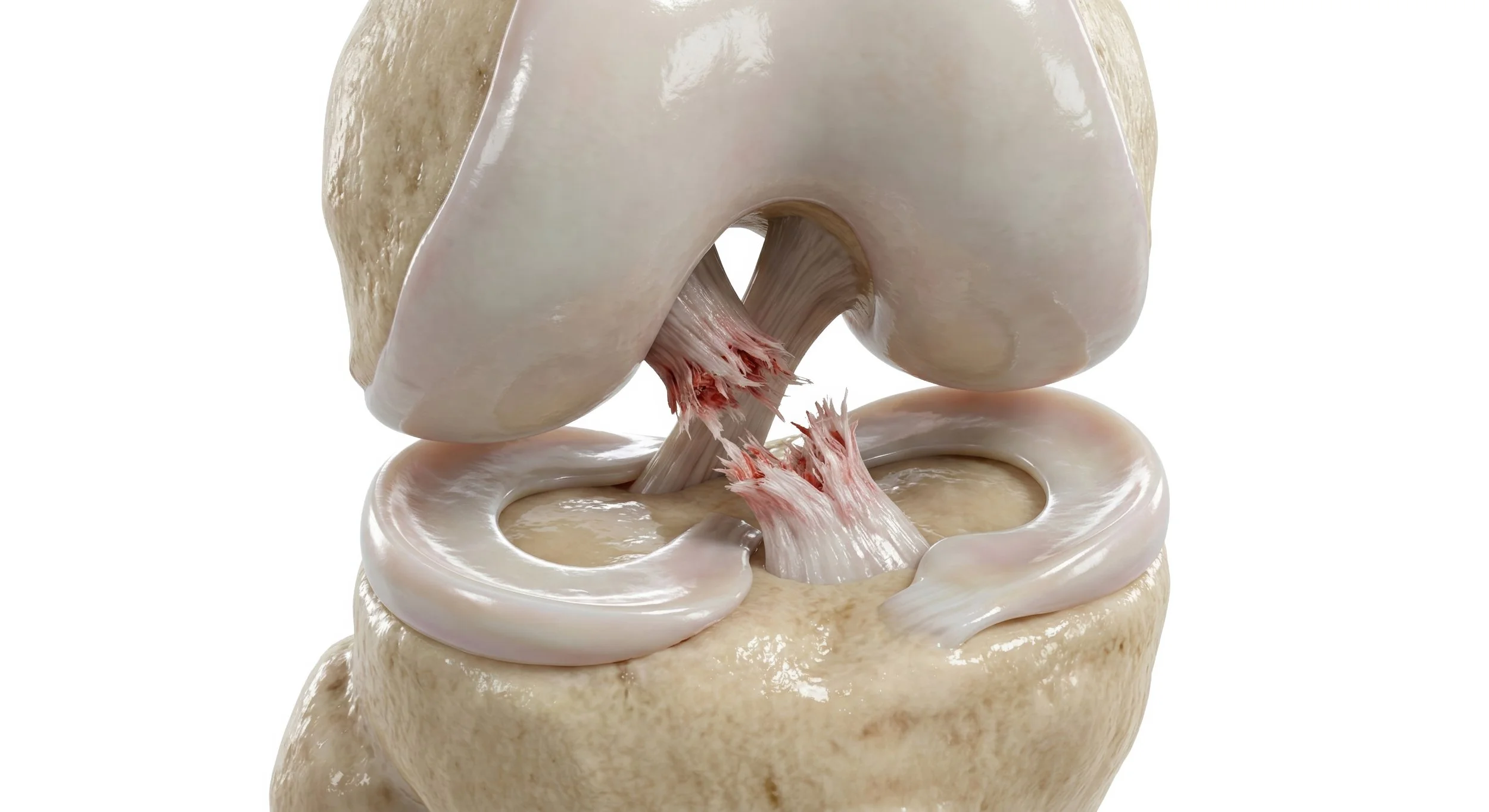
If you have been told you have an ACL tear, you likely have a long list of questions. Can it heal on its own? Do you need surgery? What does recovery actually look like? And how long before you can return to sport or the activities you love?
This article walks you through everything you need to know about ACL reconstruction - from what the ACL does, to how surgery works, to what a realistic recovery timeline looks like in New Zealand.
What Is the ACL and Why Does It Matter?
The anterior cruciate ligament (ACL) is one of the four major ligaments of the knee. It runs diagonally through the centre of the joint, connecting the femur (thigh bone) to the tibia (shin bone). Its primary role is to control rotation and prevent the tibia from sliding forward relative to the femur - making it essential for any activity that involves pivoting, cutting, jumping or changing direction.
Because of this, ACL injuries are most common in sports such as football, rugby, netball, basketball, skiing and tennis. However, ACL tears can also occur in everyday activities; a misstep off a kerb, a slip on a wet surface, or an awkward landing from a low height.
In New Zealand, ACL injuries sustained through an accident are frequently covered by ACC, which can significantly reduce the out-of-pocket cost of assessment and treatment. Learn more about how ACC works for orthopaedic injuries.
How Does an ACL Tear Happen?
The vast majority of ACL tears are non-contact injuries. A typical mechanism involves planting the foot and pivoting sharply, landing awkwardly from a jump, or decelerating suddenly while running. Many patients describe hearing or feeling a distinct “pop” at the moment of injury, followed by immediate swelling and a feeling of the knee giving way.
Contact injuries, such as a direct blow to the outer knee, account for a smaller proportion of ACL tears and are more common in contact sports such as rugby.
Symptoms of an ACL Tear
The most common symptoms following an ACL injury include:
A “pop” or “snap” felt or heard at the time of injury
Significant swelling within the first few hours, caused by bleeding into the joint (haemarthrosis)
A feeling of instability or the knee giving way, particularly when pivoting or changing direction
Difficulty bearing full weight immediately after the injury
A loss of full range of motion in the knee
Not all ACL tears produce dramatic initial symptoms. Some patients continue playing after the injury before seeking medical attention, only to find the knee repeatedly giving way in the days and weeks that follow.
How Is an ACL Tear Diagnosed?
If an ACL tear is suspected, your GP or physiotherapist will typically arrange x-rays to rule out a fracture, and refer you to an orthopaedic surgeon for further assessment. Clinical examination, particularly the Lachman test and pivot shift test, provides important information about the degree of instability and guides the initial clinical impression.
An MRI scan is the definitive investigation for confirming an ACL tear. Importantly, MRI also identifies associated injuries. Meniscus tears, cartilage damage, and injuries to other ligaments frequently occur alongside ACL tears and must be identified before any treatment decisions are made. MRI is arranged through your orthopaedic surgeon following referral - it is not typically available through a GP alone.
Do You Need Surgery?
Not every ACL tear requires surgery. The decision depends on a number of individual factors, including your age, activity level, the degree of instability in the knee, any associated injuries, and your goals for recovery.
Conservative management - involving physiotherapy, bracing and activity modification - may be appropriate for:
Older or less active patients who are willing to modify their sport and activity participation
Patients with low-grade instability and no associated meniscus or cartilage damage
Patients with significant medical comorbidities that increase surgical risk
ACL reconstruction is generally recommended for:
Younger, active patients who wish to return to pivoting or cutting sport
Patients with significant instability that affects everyday activities or work
Patients with associated meniscus tears requiring surgical repair
Patients who have undergone a structured physiotherapy programme but continue to experience giving way
The most important step in this decision is a thorough conversation with your orthopaedic surgeon about your specific circumstances, lifestyle and goals. There is no single right answer. The right treatment is the one that aligns best with what you want to be able to do.
What Does ACL Reconstruction Involve?
ACL reconstruction is a keyhole (arthroscopic) surgical procedure performed under general anaesthetic, typically as a day procedure. Because the torn ACL cannot heal or be repaired, it is replaced with a graft taken from another tendon in your body.
The most commonly used grafts in New Zealand are:
Hamstring tendon graft: A portion of the hamstring tendons is harvested through a small incision below and medial to the knee. This is the most frequently used graft option internationally with well-established long-term outcomes.
Patella tendon graft: A central strip of the patella tendon is taken, along with small bone plugs at each end, providing robust fixation. Favoured in some higher-demand athletes.
Quadriceps tendon graft: Increasingly used, particularly in revision ACL cases or where other grafts are unavailable.
Graft selection is individualised and will be discussed with you prior to surgery based on your specific circumstances.
Through two or three small arthroscopic portals in the knee, the surgeon removes any damaged tissue and creates tunnels in the femur and tibia through which the graft is passed and secured. The graft is fixed with screws or buttons, replicating the path and function of the original ligament. The procedure typically takes 60–90 minutes.
For patients whose injuries occurred through an accident, ACC will usually cover the cost of surgery. Your surgeon’s team will advise on the ACC process and assist with any required documentation.
ACL Reconstruction in Children and Adolescents
ACL injuries in children and adolescents require a different approach to adults. Because the growth plates (physes) are still open, standard drilling techniques risk damage that can result in leg length discrepancy or angular deformity. Management is therefore guided by skeletal maturity rather than age alone.
Prepubescent (skeletally immature)
Boys with a bone age of 12 years or under, and girls with a bone age of 11 years or under, are managed with a physeal-sparing technique. Dr Boyle performs the Micheli-Kocher physeal-sparing ACL reconstruction using an iliotibial band autograft - a technique that avoids physeal drilling entirely while restoring knee stability.
Older adolescent (approaching skeletal maturity)
Boys aged approximately 13-16 and girls aged approximately 12-14 (bone age) undergo a modified transphyseal reconstruction using a hamstring autograft, with a slightly more vertical femoral tunnel orientation to minimise physeal risk. A lateral extra-articular tenodesis is added to further control rotational instability.
Closing or closed physes
Once the growth plates are approaching closure, standard transphyseal ACL reconstruction is appropriate.
Determining the right approach requires careful assessment of skeletal maturity, including bone age imaging. If your child has sustained an ACL injury, an early specialist assessment is important to guide appropriate management.
Recovery and Return to Sport
Recovery from ACL reconstruction is a significant commitment - it is one of the longer rehabilitation journeys in orthopaedic surgery. A realistic timeline for return to full competitive sport is 6-12 months, with structured, physiotherapy-guided rehabilitation throughout. Attempting to return too early significantly increases the risk of re-injury.
A general rehabilitation timeline:
Weeks 1-2: Control swelling and pain. Achieve full knee extension. Begin gentle range-of-motion exercises and quadriceps activation. Partial weight-bearing with crutches.
Weeks 2-6: Progressive weight-bearing. Discontinue crutches when walking normally. Strengthening exercises for the quadriceps, hamstrings and gluteal muscles.
Months 2-4: Advanced strengthening, cycling, swimming and hydrotherapy. Early functional movement patterns.
Months 4-6: Running programme begins when sufficient quadriceps strength is confirmed on objective testing. Sport-specific conditioning.
Months 6-9: Agility training, cutting, pivoting and sport-specific drills under physiotherapy supervision.
Months 9-12: Return to competitive sport when objective strength, movement quality and psychological readiness criteria are met. Most patients are back to straight-line running and gym-based training by around six months, but a return to pivoting sport usually takes nine to twelve.
Return to sport decisions should be based on objective testing results, not time elapsed alone. Your surgeon and physiotherapist will guide you through this process. Learn more about post-operative rehabilitation.
Reducing the Risk of Re-Injury
Re-injury after ACL reconstruction is a genuine risk, particularly in younger patients returning to high-risk pivoting sports. Evidence-based prevention programmes - including neuromuscular training, single-leg landing technique, and progressive loading protocols - significantly reduce this risk and should be incorporated into rehabilitation from an early stage and continued after return to sport.
Getting a Referral for an ACL Injury
If you have sustained a knee injury that may involve the ACL, the first step is to see your GP or physiotherapist. They can arrange initial x-rays and provide a referral to an orthopaedic surgeon for further assessment. If your injury occurred through an accident, ACC usually covers your assessment and treatment.
Dr Matthew Boyle is a fellowship-trained orthopaedic surgeon based in Auckland, specialising in knee surgery and sports injury management. His clinic is located at AUT Millennium, 17 Antares Place, Rosedale, Auckland. To request an appointment, ask your GP or physiotherapist for a referral or contact the clinic directly. GPs and physiotherapists can refer via HealthLink EDI: drmboyle.
This article is for general educational purposes only and does not constitute medical advice. Please consult your doctor or seek a specialist referral for personal medical advice.