

When surgery is recommended for a hip, knee or shoulder problem, one of the first questions most people ask is how it will be paid for. In New Zealand, the answer depends on how the problem started, whether you have health insurance, and how soon you need treatment.
There are four main ways orthopaedic surgery is funded: ACC, private health insurance, self-funding and the public hospital system. This guide explains how each one works, what to expect, and the questions worth asking before surgery is booked.
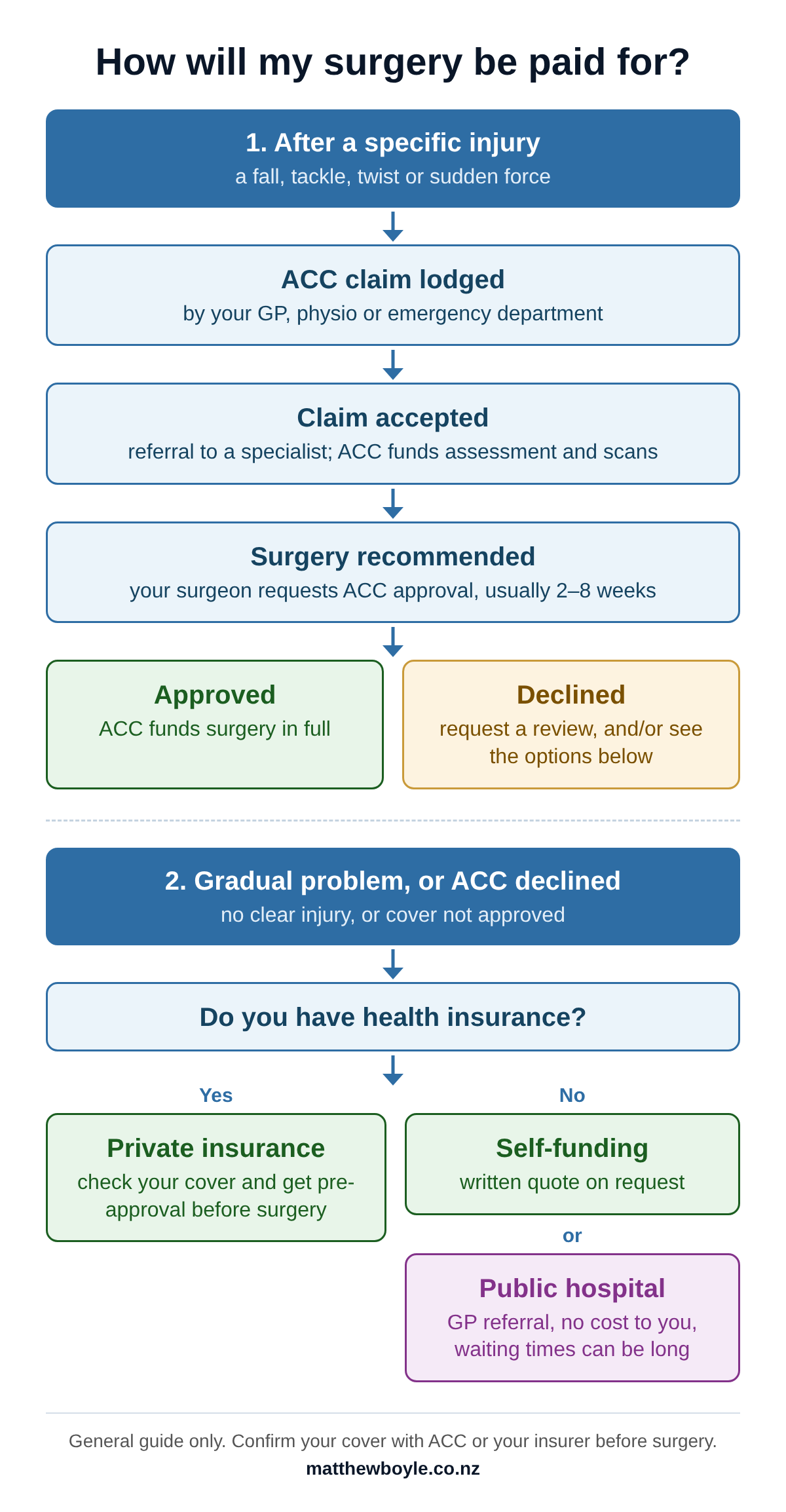
How orthopaedic surgery is funded in New Zealand.
ACC
ACC (the Accident Compensation Corporation) provides no-fault cover for injuries that happen in New Zealand. It covers New Zealand residents and visitors, and if your claim is accepted you are covered whether or not you have health insurance. Many sports injuries that need orthopaedic surgery are funded through ACC.
What ACC Covers
ACC covers personal injury caused by an accident: damage from a specific event such as a fall, a tackle, a twisting injury or a sudden, unexpected force on the joint. ACC does not cover changes that develop gradually with age or wear and tear, even when they cause significant pain.
Injury or Degeneration?
This distinction is the most common source of confusion. Scans of adult joints often show both an injury and some age-related change, particularly from middle age onwards. If ACC considers that your symptoms are mainly due to degeneration rather than the injury, it may decline cover for surgery even if your original claim was accepted. This does not mean your symptoms are not real or that surgery would not help. It only means ACC is not the funder.
Your First Specialist Appointment
An ACC claim is usually lodged by your GP, physiotherapist or emergency department at your first visit after the injury. To see an orthopaedic specialist through ACC, you need a referral from your GP, physiotherapist or another registered practitioner. If you would like to see a particular specialist, the referral should name them.
Once your claim is accepted, ACC funds your first specialist assessment and any imaging such as x-rays, MRI or CT scans requested at that appointment.
Approval for Surgery
ACC cover for your injury does not automatically mean ACC will fund surgery. If you and your surgeon decide that surgery is the right option, your surgeon sends ACC an Assessment Report and Treatment Plan requesting approval.
Straightforward traumatic injuries, such as an ACL tear, are usually approved by ACC within two to three weeks. More complex conditions, such as rotator cuff tears and hip injuries, often take six to eight weeks, and sometimes longer if ACC needs more information. ACC will write to you with its decision, and once surgery is approved, your surgeon’s practice can book a date.
Once surgery is approved, ACC funds it in full, so there is no cost to you.
If ACC Declines Your Claim
If ACC declines surgery, it will write to you explaining why and setting out your options. ACC also funds one further appointment with your surgeon to talk these through. Your options are to:
Ask ACC to review the decision
Use private health insurance, if you have it
Pay for surgery yourself
Be referred to the public hospital system
A review is the formal first step in challenging an ACC decision, and you need to apply within three months of the decision. A review usually takes around three months or more to be resolved. Free, independent advocacy services can help you prepare and can support you at the review hearing. ACC can provide details.
More detail on the ACC process is available on the Working with ACC page.
Private Health Insurance
If your problem is not covered by ACC, or you have been declined and would rather not wait for a review, private health insurance is the most common way surgery is funded. Policies vary widely, so it is worth checking your cover before your first appointment rather than after surgery has been recommended.
Check What Your Policy Covers
Most surgical policies cover the operation itself, including the surgeon, anaesthetist and hospital costs. Specialist appointments and scans such as MRI are covered by some policies but not others, or only up to a set limit. Your insurer can tell you exactly what your policy includes.
Policies also differ in how much of the cost of surgery they pay. Some cover the full cost after an excess, a fixed amount you pay towards each claim, which may be higher if you chose an elective excess to reduce your premiums. Others pay a set percentage, often 80%, and you pay the rest.
Pre-Approval
Almost all insurers require approval before surgery goes ahead. Once surgery is recommended, your surgeon’s practice will give you the procedure details and an estimate of costs to send to your insurer, or will send them on your behalf. Do not book surgery until your insurer has confirmed approval in writing.
Affiliated Providers
Some insurers have networks of surgeons and hospitals with pre-agreed prices, such as Southern Cross Affiliated Providers or nib First Choice. When your surgeon is part of your insurer’s network, costs are usually paid directly and you are less likely to face a gap between the cost of surgery and what your policy pays. Outside a network, there may be a gap between what your policy pays and the total cost, sometimes called a co-payment, which you pay yourself.
Pre-Existing Conditions
Conditions that existed before you took out your insurance policy, or before you upgraded it, may be excluded. Exclusions can be permanent or apply for a stand-down period. If your policy is new, check whether any waiting periods apply.
Insurance and ACC Together
If ACC accepts your injury, ACC is usually the funder, and insurers generally do not pay for treatment that ACC covers. If ACC declines surgery and you have insurance, you may be able to have surgery through your insurer while an ACC review is underway. Your insurer can advise how this works under your policy.
Self-Funding
If your surgery is not covered by ACC or insurance, you can choose to pay for it yourself. Self-funding means surgery can usually go ahead without the waiting times of the public system.
What Is Included in a Quote
The total cost depends on the procedure and usually includes the surgeon’s fee, the anaesthetist’s fee, the hospital and operating theatre costs, and any implants used. Scans, physiotherapy and follow-up appointments may be charged separately. A written quote is available on request, so you know the costs before deciding.
The Public Hospital System
If your surgery is not covered by ACC and you do not have health insurance, your GP can refer you to the orthopaedic service at your local public hospital. If you are eligible for publicly funded healthcare, there is no cost for treatment.
Public hospitals assess referrals according to clinical need, and there can be significant delays both for a first specialist appointment and for surgery. Not every referral for non-urgent surgery will be accepted. If you are referred and your symptoms change or worsen while you wait, let your GP know.
Questions to Ask Before Surgery
Has ACC accepted my claim, and has surgery been approved?
If I have insurance, does my policy cover this procedure, and has it been pre-approved?
Is my surgeon part of my insurer’s network?
What will I need to pay myself, including any excess, co-payment or costs not covered?
Are scans, physiotherapy and follow-up appointments included?
If I am self-funding, can I have a written quote?
Key Points
Orthopaedic surgery in New Zealand is funded through ACC, private health insurance, self-funding or the public hospital system.
ACC covers injuries caused by an accident, not gradual wear and tear. Approval for surgery is a separate step that usually takes two to eight weeks, sometimes longer.
If ACC declines, you can request a review within three months, and you can use insurance, self-fund or seek public hospital care in the meantime.
Private insurance almost always requires pre-approval before surgery. Check your cover, network and excess early.
Self-funded surgery is quoted in advance, on request.
Public hospital treatment is free for eligible patients, but waiting times can be long and access is based on clinical need.
This article is intended for general educational purposes and does not constitute medical, legal or financial advice. ACC processes, insurance policies and public hospital criteria vary and change over time, so please confirm your cover directly with ACC or your insurer. If you are experiencing hip, knee or shoulder pain, please see your GP or physiotherapist in the first instance.