

What Is a SLAP Tear?
A SLAP tear is an injury to the labrum of the shoulder - specifically at the point where the biceps tendon attaches to the top of the glenoid socket. SLAP is an acronym for Superior Labrum Anterior to Posterior, describing the location of the tear: the superior (upper) labrum, running from the front to the back of the shoulder.
The shoulder is a ball-and-socket joint. Because the socket (glenoid) is naturally shallow, the labrum (a ring of fibrocartilage surrounding the rim) deepens it and improves stability. At the very top of the labrum, the long head of the biceps tendon anchors directly into the bone. This structure is called the biceps-labral complex, and it is here that SLAP tears occur.
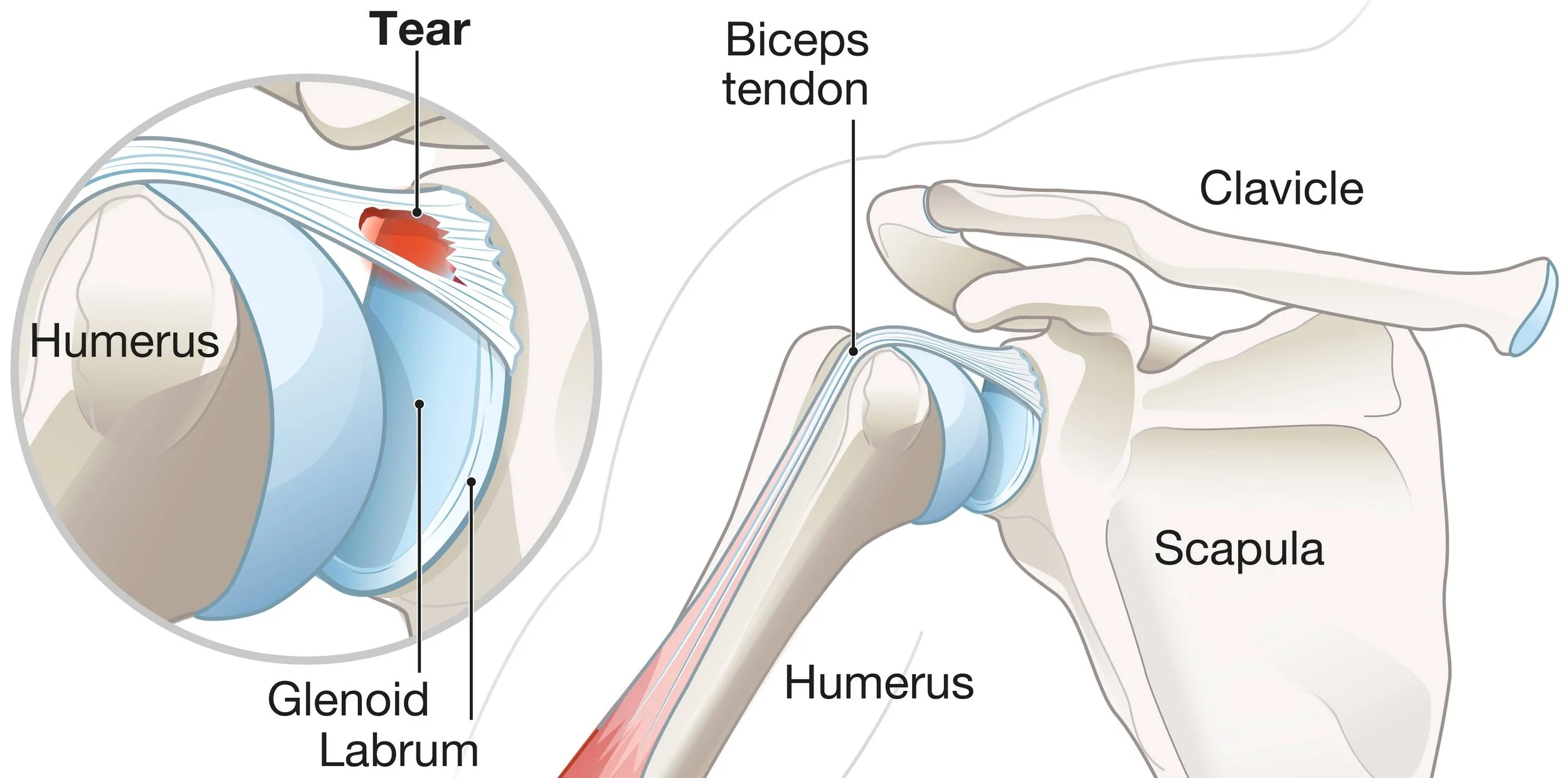
A SLAP tear occurs where the biceps tendon anchors to the labrum at the top of the shoulder socket.
Types of SLAP Tears
SLAP tears are classified using a system developed by Snyder and colleagues, with Type I and Type II being the most clinically common.
Type I
Fraying of the superior labrum without detachment from the bone. This is a degenerative pattern often seen incidentally in older patients. It rarely causes significant symptoms on its own and does not typically require surgical treatment.
Type II
The biceps-labral complex is detached from the glenoid rim. This is the most common type requiring surgical treatment and the one most likely to cause persistent shoulder pain and functional limitation. Type II tears are most often seen in overhead athletes, throwing athletes, and manual workers following repetitive loading of the biceps anchor.
Type III and Type IV
Type III tears involve a bucket-handle tear of the superior labrum with the biceps anchor remaining intact. Type IV tears extend into the biceps tendon itself. Both are less common. Management depends on the degree of tendon involvement and the patient's age and functional demands.
Who Gets SLAP Tears?
SLAP tears occur across a wide range of patient groups, though the mechanism varies.
Overhead and Throwing Athletes
Swimmers, tennis players, volleyball players, cricketers, and throwing athletes are among the most commonly affected. In these sports, repetitive traction and rotational forces at the biceps anchor cause gradual fatigue failure of the labral attachment. Symptoms often develop insidiously over months rather than following a single event.
Manual Workers
Occupations involving repetitive overhead lifting, pulling, or reaching (eg. trade workers, builders, and labourers) can develop SLAP tears through cumulative loading rather than acute injury. Symptoms typically include a deep ache within the shoulder and pain with specific tasks.
Acute Injury
A sudden traction force - catching a heavy falling object, a fall onto an outstretched arm, or a shoulder dislocation - can detach the biceps anchor acutely. This mechanism is less common than the repetitive-loading pattern but should be considered when a clear injury event precedes symptom onset.
Symptoms
SLAP tears can be difficult to distinguish from other shoulder pathology on clinical grounds alone. Common presentations include:
A deep ache within the shoulder, often described as being inside the joint rather than on the surface
Pain with overhead activities - reaching above shoulder height, throwing, swimming strokes, or serving in tennis
Pain with lifting and pulling movements, particularly with a straight or slightly bent arm
A clicking, catching, or clunking sensation within the shoulder during certain movements
Weakness or loss of confidence with overhead or throwing activities
Rotator cuff pathology, subacromial impingement, and AC joint problems can produce overlapping symptoms. It is important that the shoulder is assessed thoroughly to identify the primary source of pain before any surgical decision is made.
Diagnosis
Diagnosis of a SLAP tear involves clinical assessment combined with imaging.
Clinical Examination
Several specific tests are used to stress the biceps-labral complex and reproduce symptoms. These include provocative manoeuvres loading the biceps anchor in specific positions. While useful as part of a structured assessment, no single clinical test is sufficiently accurate in isolation to confirm or exclude a SLAP tear; the diagnosis requires the full clinical picture.
MRI Arthrogram
MRI arthrogram, where contrast is injected into the shoulder joint before the scan, is the most accurate imaging study for SLAP tears. The contrast agent outlines the labrum and improves detection of partial or complete detachments that may not be visible on standard MRI. Plain MRI without contrast is less reliable for this diagnosis and may miss significant tears.
In New Zealand, MRI arthrogram is arranged through a specialist following referral. It is not usually available directly through a GP or physiotherapist.
Plain x-rays do not show labral pathology but are useful for excluding other causes of shoulder pain, particularly in older patients where degenerative joint change or calcific tendinitis may be contributing.
Diagnostic Arthroscopy
In some cases, the diagnosis is only confirmed at the time of surgery. Arthroscopy allows direct visualisation of the biceps-labral complex and assessment of labral stability under dynamic conditions - information that imaging alone cannot always provide.
Treatment
Non-Surgical Management
Not all SLAP tears require surgery. Type I tears (fraying without detachment) are managed non-surgically in most cases. A structured physiotherapy programme focusing on rotator cuff strengthening, scapular stabilisation, and activity modification can provide satisfactory relief for a significant proportion of patients.
For Type II tears with significant symptoms and functional limitation, a trial of physiotherapy is generally the appropriate first step. Surgery is considered when non-surgical management has failed to restore acceptable function over a reasonable period.
Biceps Tenodesis
For most patients with a symptomatic Type II SLAP tear requiring surgery, biceps tenodesis is the preferred procedure. In this operation, the long head of the biceps tendon is released from its attachment at the top of the labrum and reattached to the upper arm bone (humerus) at a lower point, eliminating the abnormal traction force at the biceps anchor.
Evidence from multiple comparative studies has demonstrated that tenodesis produces reliable pain relief and functional recovery with a lower rate of revision surgery compared with direct SLAP repair, particularly in patients over 35 years of age, manual workers, and overhead athletes. Tenodesis also avoids the technical complexity and risk of re-tear associated with suture repair of the labrum.
The procedure is performed arthroscopically in most cases, through small keyhole incisions, using suture anchors to secure the tendon at its new attachment point.
Labral Repair
In some patients, once the biceps tendon has been released and the traction force on the superior labrum removed, the labrum remains unstable or structurally detached. Where this is found at the time of surgery, the labrum is repaired arthroscopically in addition to the tenodesis, using suture anchors to reattach the torn labral tissue to the glenoid rim. The decision to add labral repair is made at the time of surgery, based on direct assessment of labral stability.
Subpectoral Biceps Tenodesis
In revision cases or where the shoulder anatomy is complex, the biceps tendon can be reattached at a more distal position (beneath the pectoralis major muscle) through a small incision below the shoulder. This subpectoral approach is reserved for specific situations where the standard arthroscopic technique is not appropriate, such as when re-anchoring a previously failed tenodesis or when proximal groove pathology is a contributing factor.
Recovery
Recovery from biceps tenodesis is structured and progressive. The timeline below is a general guide - your specific programme will be directed by your physiotherapist in consultation with your surgeon.
Weeks 1-4
The arm is supported in a sling. Pendulum exercises and gentle passive range of motion are begun early. The priority in this phase is protecting the tendon repair while it begins to heal.
Weeks 4-8
The sling is discontinued. Active range of motion exercises begin, progressing gradually. Rotator cuff and scapular strengthening is introduced as tolerated. Most patients can manage light daily tasks by the end of this phase.
Weeks 8-12
Strengthening progresses. Most patients can return to light manual work and non-overhead recreational activities during this period.
Months 3-6
Return to overhead sport, throwing activities, and heavy manual work typically occurs between four and six months, guided by functional recovery and physiotherapy assessment rather than a fixed calendar. Full strength and confidence in the shoulder generally returns in this window for most patients.
Overhead and Throwing Athletes
Return to full competitive throwing or overhead sport may take six months or longer, depending on the demands of the sport and individual recovery. A graduated return-to-throwing programme is recommended before full match play is resumed.
Key Points
SLAP stands for Superior Labrum Anterior to Posterior; the injury involves the attachment point of the long head of the biceps tendon within the shoulder joint
Type II SLAP tears, where the biceps anchor is detached from the glenoid, are the most common type requiring surgical treatment
MRI arthrogram is the most accurate imaging study for SLAP tears; standard MRI without contrast is less reliable
Biceps tenodesis (releasing and reattaching the tendon at a lower point) is the preferred surgical approach for most patients, with good evidence supporting lower reoperation rates compared with direct SLAP repair
In some patients, the labrum is repaired in addition to tenodesis, depending on what is found at the time of surgery
Recovery takes four to six months for most patients to return to overhead sport and heavy lifting
This article is intended for general educational purposes and does not constitute medical advice. Every patient's situation is different. Diagnosis and treatment decisions should always be made in consultation with a qualified specialist. If you are experiencing shoulder pain or instability, please see your GP or physiotherapist in the first instance.